
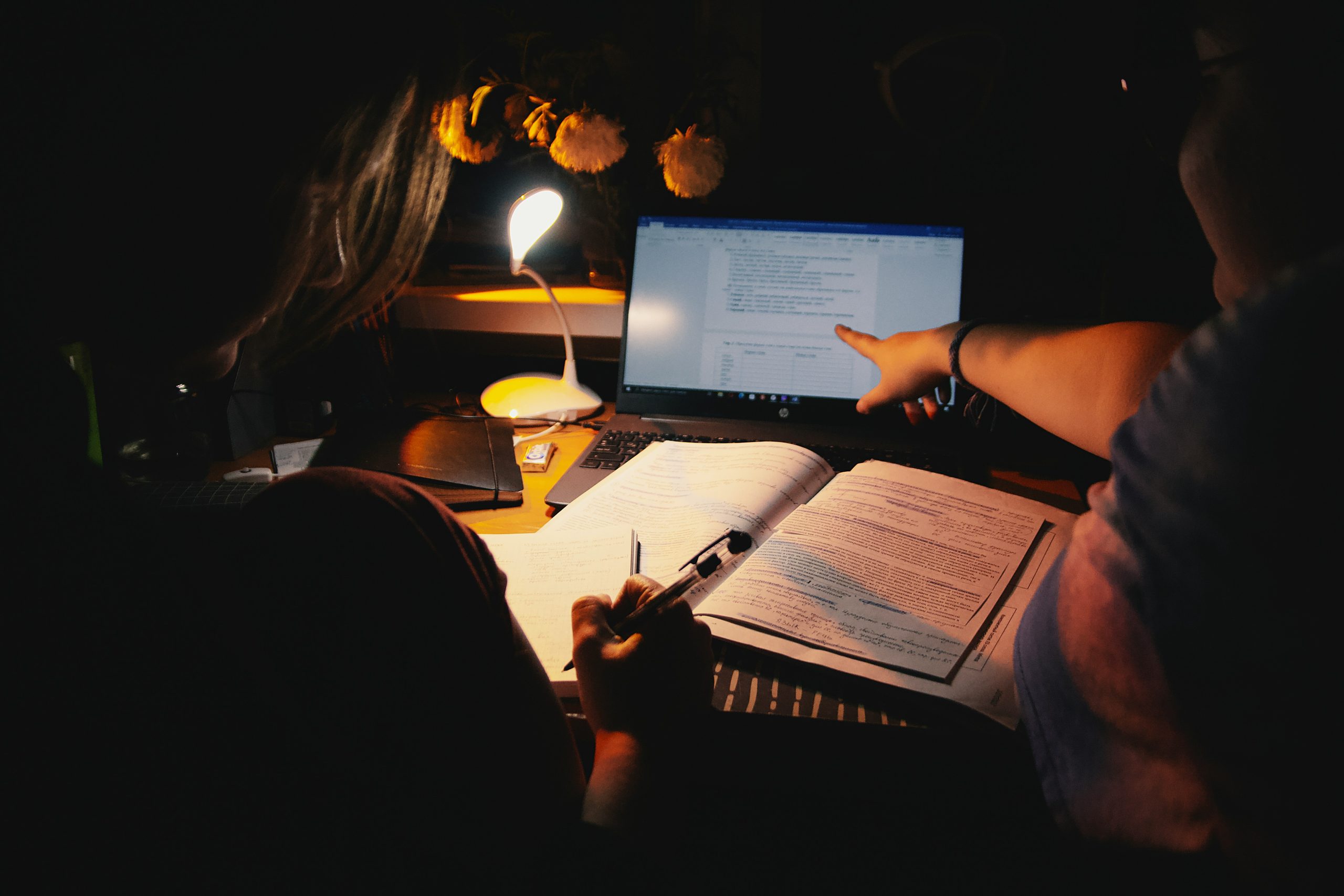
Feature image credit: Карина Низаметдинова on Unsplash
By Ly-ann Tan Low
Ly-ann Tan Low is a homeschooling parent, former MOE teacher, Literature educator, and accredited Institute for Excellence in Writing instructor. She holds First Class Honours in Post-Colonial English Literature and Art History and a Postgraduate Diploma in Education in English Language and Literature, and has spent over twenty years teaching students to read closely, think carefully, and write with increasing independence, across Singapore, Japan, and Hong Kong. She is also trained in AI for learning design. She runs LitLens Studio, a homeschool writing programme in Singapore.
Disclosure: The author runs LitLens Studio, which offers writing instruction to families. This piece’s argument overlaps with the service her studio provides. The author and editor agreed that disclosure was important so readers can weigh the argument with that context in mind.
My oldest daughter sat for the PSLE this year. Naturally, I wanted to gauge how ready she was for the national exam. So I piled her with past-year prelim papers, and for a week we became a machine: she completed a paper, I marked it, and she moved on to the next. English. Math. Science. And then came Chinese.
I was completely stumped by the composition. I did not know the language well enough to read or mark it properly, and my knowledge of the Singapore Examinations and Assessment Board’s1 Mother Tongue papers was too thin to offer any useful guidance. So, like many homeschooling parents, I turned to my trusted WhatsApp groups.
“I don’t know if this composition is good or not,” I wrote. “It sounds okay to me, but I have no real sense of the standard.”
The interwebs suggested I scan it and ask ChatGPT to mark it. After it told me it had “thought for 13 seconds”, ChatGPT told me, “Some openings and endings are weak. Paragraph logic could be tighter. Transitions need work. Sentence variety is limited. Verbs are too plain. Descriptions could be more vivid.” Well, I thought that sounded insightful.
But it wasn’t.
The Feedback That Told Me Everything and Nothing
As an English Language teacher, I knew exactly what those comments meant. I could picture the sentence-level issues, name the fix, model the revision, and design targeted exercises to scaffold her learning in the right order. But in Chinese, I had no idea how to use the feedback. When I asked ChatGPT for specifics, it suggested where those improvements could be, but that only made it more frustrating. It was like watching a chess game mid-match with no idea how we got there. The gap looked so easy to close, but it was still entirely beyond my grasp.
“Okay, so she may be ready, there are these things she could do better, and she should try to phrase her sentences like so…” I thought to myself, “but how do I guide her to improve in the area of transitions and not just in this story?”
One way Singapore parents make their opening move for the PSLE preparations is by heading straight to our beloved Popular Bookstore and buying stacks of Primary 6 model compositions or exam-prep essay workbooks. It is an affordable, concrete, and immediately accessible solution for the bewildered parent who does not know what good composition writing looks like, how it is judged, or how to help their child move from “sounds okay” to “exam-ready.” These books are the North Star of composition writing.
“This is what a good paragraph looks like.”
“Look at the hundreds of Chinese idioms packed into a 300-word composition.”
“This is how you should write about catching another student behaving suspiciously.”
“This must be good writing! Memorize it! Reproduce it! Use it in the exam!”
Of course, we all know these model essays do not make our children better writers. After reading ten compositions about confronting a misguided friend, our children may be able to reproduce that particular exam genre. We should not expect them to write business emails, reports, or thoughtful discussions in Mandarin in the future. At best, we hope the process helps our students write to meet the exam expectations.
A Better Sentence Does Not Make a Better Writer
The AI writing feedback I received has that same architecture. It told me what good writing should look like; which sentences my daughter should rewrite; and showed me a sample of what it could look like. But we never learned the writer’s craft underneath those changes. We did not learn who the piece was really addressing, how specific phrasing shaped the reader’s response, or why certain authorial decisions made the writing clearer, stronger, or more persuasive. We were given the improved product, but not the thinking process behind it.
When I ask AI for feedback on my child’s composition, feedback designed around what the syllabus is looking for, I am showing my child how to learn the pattern that ChatGPT has internalized. That is what a large language model is built upon: identifying and reproducing patterns and using algorithms to predict what words come next.
AI can show my child another way to write a better sentence, but unless she learns why it works, she has not become a better writer. She has only borrowed a better version.
The limitation of using AI feedback on writing is the same as a word processor’s spell checker. It flags the error and suggests the correct spelling, but it cannot teach spelling. At best, we may memorize the order of letters in a word. However, we have not learned the phonics, patterns, roots, or rules that explain why a word is spelled that way, or how words come together. But spelling and writing are not the same kind of skill. Spelling has one correct answer: once a child knows how to access their spelling skill – whether by sight or phonics. Writing has no fixed answer. Every sentence is a fresh judgment call by its writer for whom it is intended, what the reader needs to feel, and what word the register demands. There is little cost to using a spell checker because nothing is left to learn beyond a word’s correct spelling. However, AI feedback hands over an ongoing skill that is one less judgment call for the student to make and one less opportunity to cultivate style.
Without that cognitive struggle, there is no genuine understanding. Learning was never supposed to stop at the answer. What we want is the thinking behind it.
The Chess Player Who Didn’t Know She Didn’t Know

Judit Polgár, often described as the greatest female chess player in history, made a similar point in a recent podcast about AI and chess. As a junior, the only player rated above her in their age group was a then-twelve-year-old British boy named Demis Hassabis, the same Hassabis who now leads Google DeepMind and won the 2024 Nobel Prize in Chemistry. Chess was the first profession reshaped by artificial intelligence. Since AI chess engines emerged, it has become central to preparation, and players can memorize opening moves in impressive detail. But if an opponent should depart from that sequence, the player may be lost. The board no longer looks like what they had prepared. From that moment, they do not know how to read the position, evaluate the dynamics, or find a new plan because they have only memorized a sequence of moves, not learned to think through unfamiliar arrangements of pieces.
Image credit: Callum Mullin on Unsplash
As Polgár put it, “It’s not even nothing. It’s worse than nothing, because you think you know it, but you don’t know it.”2 Their false confidence has crumbled. The damage is invisible until the tool is removed.
But my point about chess is only tangential. The real analogy is that both chess engines and AI feedback can make the next move look obvious while concealing the thinking that makes it meaningful. A student may accept a better sentence in the same way a player memorizes a better move. The writing looks stronger, but the child has not learned how tone, structure, emphasis, and audience shape meaning. When the next writing task changes, she may be just as lost as the chess player whose opponent has departed from the prepared sequence.
Traditional writing and assessment, as we know it, rests on the human-to-human feedback loop that connects creation to assessment. A model essay, at least in theory, is written by a human, for a human: the hallowed SEAB marker. We may roll our eyes at the over-the-top formulaic exam writing, but at least the student is imitating a human voice for a real audience. The piece still feels like it serves a particular communication function. In an ideal scenario, a trained marker interprets the rubric and weighs content, intent, and edge cases against values such as what good writing is meant to achieve through purpose, audience, context, and tone. A rubric doesn’t do the marking without the lens of the marker.
Even so, the PSLE marker looks for figures of speech and sentence variety as much as for genuine response. If the PSLE has already narrowed writing towards a pattern, then further AI feedback entrenches it, drawing a student deeper into the distortion the exam already invites.
AI writing and the evaluation we get when we ask it for feedback are not for a reader but a pattern the machine has learned to recognize as “good writing.” Writers write, revise, and wrestle with words because they desire to communicate with another human being. We do not write essays for the machine to understand us. Our motivating force is connection with humanity, something a machine simply cannot understand. If students learn to write like a machine, for a machine’s evaluation, we learn the wrong pattern. Student writers need practical experience to develop their voice and intuition to engage their audience effectively. An AI model only predicts the statistically probable next word. That is the deep problem of AI writing feedback.
What Singapore’s Debate Tells Us
Lately, there has been a lot of parental noise about schools in Singapore introducing AI to students from Primary 4 onward. Parents’ concerns are concrete and specific. The children are too young; their pliable minds need more time to develop; efficiency can wait; and in the meantime, adults need to filter on their behalf until their prefrontal cortex develops executive-functioning skills they can rely on. These apprehensions are on point.
A 2025 MIT Media Lab study found that participants who used large language models to complete their work showed weaker neural connectivity, lower memory retention, and a diminished sense of authorship than those who completed it independently.3
So, while the final grade may look identical, the student who relied on AI did not use that opportunity to build cognitive muscles through struggle.
In the study, those students could not remember it, let alone apply it the next time they saw the problem. The question is: are we working for grades or for growth?
I did a little digging into what Minister for Education Desmond Lee said in April 2026 to understand what he meant by MOE’s approach to AI.4 MOE is not naïve about the concerns parents raised. In fact, the Singapore Student Learning Space was deliberately shaped around a very different design philosophy from open-ended tools like ChatGPT. Its AI-enabled features sit inside the Student Learning Space, where the teacher controls the environment, directs and sets the task, controls the learning conditions, and reviews how feedback is used.5
I did a little digging into what Minister for Education Desmond Lee said in April 2026 to understand what he meant by MOE’s approach to AI.4

MOE is not naïve about the concerns parents raised. In fact, the Singapore Student Learning Space was deliberately shaped around a very different design philosophy from open-ended tools like ChatGPT. Its AI-enabled features sit inside the Student Learning Space, where the teacher controls the environment, directs and sets the task, controls the learning conditions, and reviews how feedback is used.5
In that same spirit, students cannot rely on the Learning Assistant (Lea) to rewrite “perfect” answers. In fact, the interface is teacher-activated and designed to present Socratic thinking questions, but it times out after a set number of tries.8 Again, the same principle applies to the Short Answer Feedback Assistant, which marks students’ responses but will not release them until the teacher adjusts the appropriate feedback. MOE describes this as something teachers can “edit and build on,” not as feedback that replaces teacher judgment.9 In theory, the system is a closed, highly supervised design based on the premise that primary-level students still need an adult to scaffold their learning.
In other words, the Student Learning Space is a closed and supervised design. It is MOE’s answer to the open “cowboy country” of ChatGPT and similar large language models: not because AI is absent, but because AI is fenced in, in direct agreement that adults should determine what the task is for, when feedback should appear, how much help is too much help, and whether the child is actually learning or merely producing a better-looking answer.
Building on MOE’s public position, Minister of State for Education Jasmin Lau’s Committee of Supply speech in March 2026 laid out the framework: learn about AI, learn to use AI, learn with AI, and learn beyond AI. MOE says the last category is the most significant and the one no AI tool can teach: responsibility, discernment, guidance, and the ability to think beyond the tool. When Carol Loi, founder of Village Consultancy, wrote to the Straits Times in April 2026, MOE’s forum reply the following week echoed the same principles: that at “lower primary, learning is print-first,” and “do not directly use AI as they develop foundational cognitive, executive functioning and socio-emotional skills through physical and social interactions.”10
That is why the recent parental anxiety around AI in classrooms is somewhat ironic. Parents got into such a furor over MOE’s eagerness to introduce AI in the classroom, arguing that open AI use, without adult supervision and scaffolding, is insufficient for primary school children and should be approached with a mile-long stick. That is exactly what MOE’s AI architects have deliberately done within their carefully designed system.
Still, a framework is only as good as the teacher applying it in a specific classroom on a specific day, and some of what looks like parental anxiety about AI may really be anxiety about how well the policy is actually exercised in individual classrooms, not about the policy itself. Ultimately, these guardrails succeed when educators and students stay in ongoing, supportive connection as they navigate the tools together in the learning environment.

Across the Chinese composition, the chess player’s prepared opening, the model essay in Popular Bookstore, and MOE’s carefully fenced classroom tools, the same pattern has surfaced: feedback becomes teaching only when a human loop keeps the reasoning behind the answer visible to the student.
The relational and policy conditions that let AI feedback earn its place are the first half of the problem. The second half of the equation concerns the child rather than the policy.
Policies can shape how these tools are used in classrooms, but they cannot see what happens inside the child’s mind as AI takes over the thinking. In Part 2, I’ll turn to that hidden cost.
* * * * *
Editor’s Note: In editing this piece, I used Claude (Anthropic) as a thinking aid to pressure-test my reads of the author’s arguments and flag factual claims that needed checking against primary sources. All editorial judgments and final decisions were my own. The author’s argument and structure are entirely hers. Phrasing was edited in places for clarity, as is standard editorial practice. The author’s own note on AI use follows below.
Author’s Note on AI Use: AI tools were used in preparing this piece as research and thinking aids, including organizing source material, testing the argument, and refining clarity. The claims, judgments, final wording, and responsibility for this article remain mine. This reflects the distinction the piece makes: AI may support thinking, but it cannot replace human judgment.
Footnotes
- SEAB is responsible for setting, administering, marking, and certifying Singapore’s major national examinations such as the Primary School Leaving Examination and the Singapore-Cambridge GCE N, O and A-level examinations. ↩︎
- Dan Fitzpatrick, “The Queen of Chess on What Schools Are Getting Wrong About AI,” Forbes, 7 May 2026, www.forbes.com/sites/danfitzpatrick/2026/05/07/the-queen-of-chess-on-what-schools-are-getting-wrong-about-ai/. ↩︎
- Nataliya Kosmyna et al., “Your Brain on ChatGPT: Accumulation of Cognitive Debt When Using an AI Assistant for Essay Writing Task,” arXiv preprint arXiv:2506.08872, 10 June 2025, www.media.mit.edu/projects/your-brain-on-chatgpt/overview/. Note: this is a preprint that had not been peer-reviewed at time of writing. ↩︎
- Desmond Lee, “MOE Committee of Supply Debate 2026: Response by Minister for Education Desmond Lee,” Parliament of Singapore, Mar. 2026, www.moe.gov.sg. ↩︎
- Lee Lin Yee, “Schools Introduce AI in Approach That Is Age- and Development-Appropriate,” The Straits Times, Apr. 2026; Ministry of Education, Singapore, “Artificial Intelligence in Education,” www.moe.gov.sg. ↩︎
- Desmond Lee, “MOE Committee of Supply Debate 2026: Response by Minister for Education Desmond Lee,” Parliament of Singapore, Mar. 2026, www.moe.gov.sg. ↩︎
- Lee Lin Yee, “Schools Introduce AI in Approach That Is Age- and Development-Appropriate,” The Straits Times, Apr. 2026; Ministry of Education, Singapore, “Artificial Intelligence in Education,” www.moe.gov.sg. ↩︎
- Ministry of Education, Singapore, “Artificial Intelligence in Education,” as cited above (n. 4). ↩︎
- Ministry of Education, Singapore, “Artificial Intelligence in Education,” as cited above (n. 4). ↩︎
- Jasmin Lau, “MOE Committee of Supply Debate 2026: Response by Minister of State for Education Jasmin Lau,” Parliament of Singapore, Mar. 2026, www.moe.gov.sg; Carol Loi Pui Wan, “Introducing AI at Primary 4 Carries a Real Developmental Risk,” The Straits Times, Apr. 2026. ↩︎
References
Fitzpatrick, Dan. “The Queen of Chess on What Schools Are Getting Wrong About AI.” Forbes, 7 May 2026, www.forbes.com/sites/danfitzpatrick/2026/05/07/the-queen-of-chess-on-what-schools-are-getting-wrong-about-ai/.
Kosmyna, Nataliya, Eugene Hauptmann, Ye Tong Yuan, Jessica Situ, Xian-Hao Liao, Ashly Vivian Beresnitzky, Iris Braunstein, and Pattie Maes. “Your Brain on ChatGPT: Accumulation of Cognitive Debt When Using an AI Assistant for Essay Writing Task.” arXiv preprint arXiv:2506.08872, 10 June 2025, www.media.mit.edu/projects/your-brain-on-chatgpt/overview/.
Lau, Jasmin. “MOE Committee of Supply Debate 2026: Response by Minister of State for Education Jasmin Lau.” Parliament of Singapore, Mar. 2026, www.moe.gov.sg.
Lee, Desmond. “MOE Committee of Supply Debate 2026: Response by Minister for Education Desmond Lee.” Parliament of Singapore, Mar. 2026, www.moe.gov.sg.
Lee, Lin Yee. “Schools Introduce AI in Approach That Is Age- and Development-Appropriate.” The Straits Times, Apr. 2026, www.straitstimes.com.
Loi Pui Wan, Carol. “Introducing AI at Primary 4 Carries a Real Developmental Risk.” The Straits Times, Apr. 2026, www.straitstimes.com.
Ministry of Education, Singapore. “Artificial Intelligence in Education.” MOE, www.moe.gov.sg.